

Why India's Durability Conversation Is Shifting from Strength Grades to Coated Reinforcement
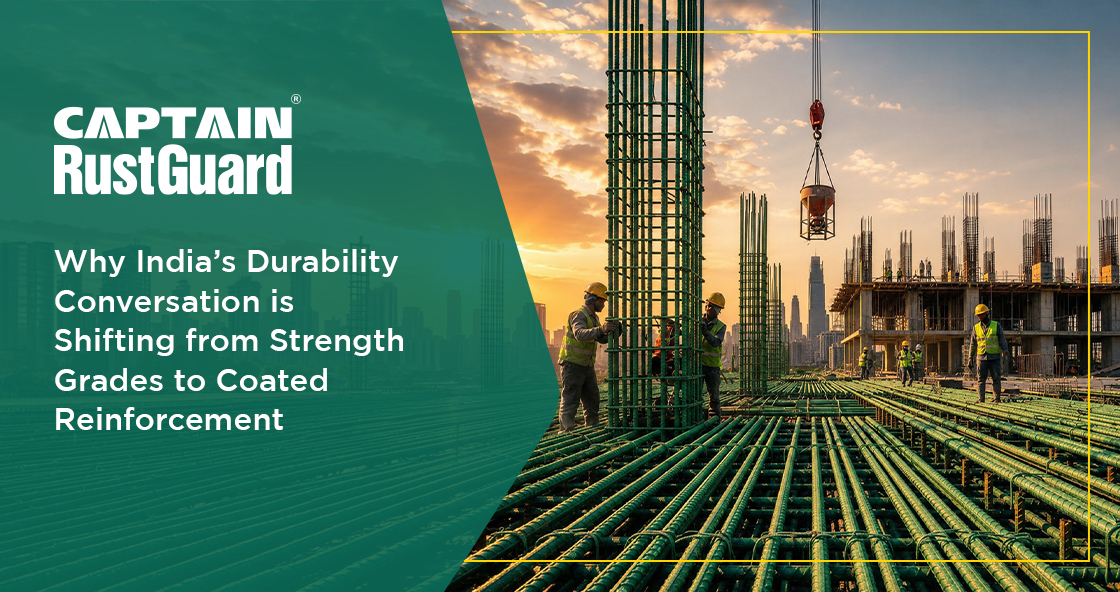
Engineers are increasingly considering environmental exposure and service life alongside strength when selecting reinforcement steel.
India's TMT industry is increasingly considering durability, exposure, and service life alongside strength when selecting reinforcement for long-term projects.
KOLKATA, WEST BENGAL, INDIA, August 21, 2026 /EINPresswire.com/ -- For most of the past three decades, an Indian reinforcement specification could be read off a single number. Fe 415 gave way to Fe 500, then to Fe 550 and Fe 600 as mills upgraded their rolling capability. Ask which was the best TMT bar in India and the answer came back as a grade.That shorthand is now under quiet revision, and the pressure is coming from engineers rather than marketers.
An inheritance worth understanding:
The strength-first habit was not a mistake. India built housing and infrastructure at pace for decades, and higher-yield steel let designers carry the same load with less material, easing congestion and cutting tonnage. Grade migration delivered real gains, and IS 1786 gave the market a common language for them.
What a grade describes, though, is how a bar behaves under load on the day it is cast. It says nothing about the fifty years that follow.
The question a yield figure cannot answer:
Reinforcement fails far more often through deterioration than through overload. Federal Highway Administration research identifies corrosion of steel reinforcing bars, driven by chlorides, as the primary cause of deterioration in reinforced concrete structures, showing up as cracking, delamination and spalling. (Source: FHWA-RD-00-081, Federal Highway Administration, 2000)
None of that is predicted by a yield strength figure. A Fe 600 bar in a chloride-heavy coastal foundation may face greater long-term threat than a Fe 500 bar inland, because the governing risk is environmental rather than structural. This is why asking which is the best TMT bar in India increasingly produces a return question about where the building stands and how long it must last.
Where the arithmetic has moved:
The economic case has given this shift momentum. Procurement has traditionally asked which material costs least today. Owners and consultants now increasingly weigh life-cycle cost: the total cost of building, maintaining and operating a structure across its design life.
Overseas research has put numbers to that logic. A University of Kansas study for the Federal Highway Administration and the Kansas Department of Transportation compared bridge decks built with uncoated and epoxy coated reinforcement. Initial cost rose US$189 to US$196 per square yard, an increment of US$7. Over a 75-year life span at a 4 percent discount rate, life-cycle cost was US$237 per square yard for the coated decks against US$444 for the uncoated. (Source: Epoxy Interest Group, Concrete Reinforcing Steel Institute, citing University of Kansas research for FHWA and Kansas DOT).
These are American bridge-deck findings, not Indian construction costs, and should not be read as a rupee estimate for any project here. What travels across borders is the shape of the curve: modest prevention early, disproportionate repair later.
A benchmark that is broadening, not replacing:
Coated reinforcement is entering this conversation as one answer among several. An epoxy-coated TMT bar carries a factory-applied barrier between the steel and the chlorides and moisture that reach it, which is useful precisely where exposure is aggressive and largely unnecessary where it is not.
Indian manufacturers have begun responding. Captain Steel India Ltd., which produces RustGuard, an epoxy coated TMT bar, alongside its seismic grades, is among those treating durability as a product category rather than an afterthought. That such lines exist at all signals a market starting to buy for service life.
Restraint matters here. The same FHWA work frames protection as a combination of sound design and construction practice, adequate cover depth, low-permeability concrete and coated reinforcing steel, while noting that because concrete tends to crack, the other measures alone will not abate the problem. (Source: FHWA-RD-00-081) Coating is one item on that list. It substitutes for none of the others, and an epoxy coated TMT bar laid in poor concrete with inadequate cover will disappoint.
The honest conclusion is unglamorous. Strength remains fundamental and grade selection still follows structural design. What has changed is that the strength number is no longer accepted as the whole answer. Anyone asking today which is the best TMT bar in India is really asking a harder question about environment, exposure and expected service life, and the industry is slowly learning to answer it that way.
Captain Steel
Captain Steel India Limited
+91 33 4011 2525
socialmedia@captainsteel.com
Visit us on social media:
LinkedIn
Instagram
Facebook
YouTube
Legal Disclaimer:
EIN Presswire provides this news content "as is" without warranty of any kind. We do not accept any responsibility or liability for the accuracy, content, images, videos, licenses, completeness, legality, or reliability of the information contained in this article. If you have any complaints or copyright issues related to this article, kindly contact the author above.
